 Skip to content

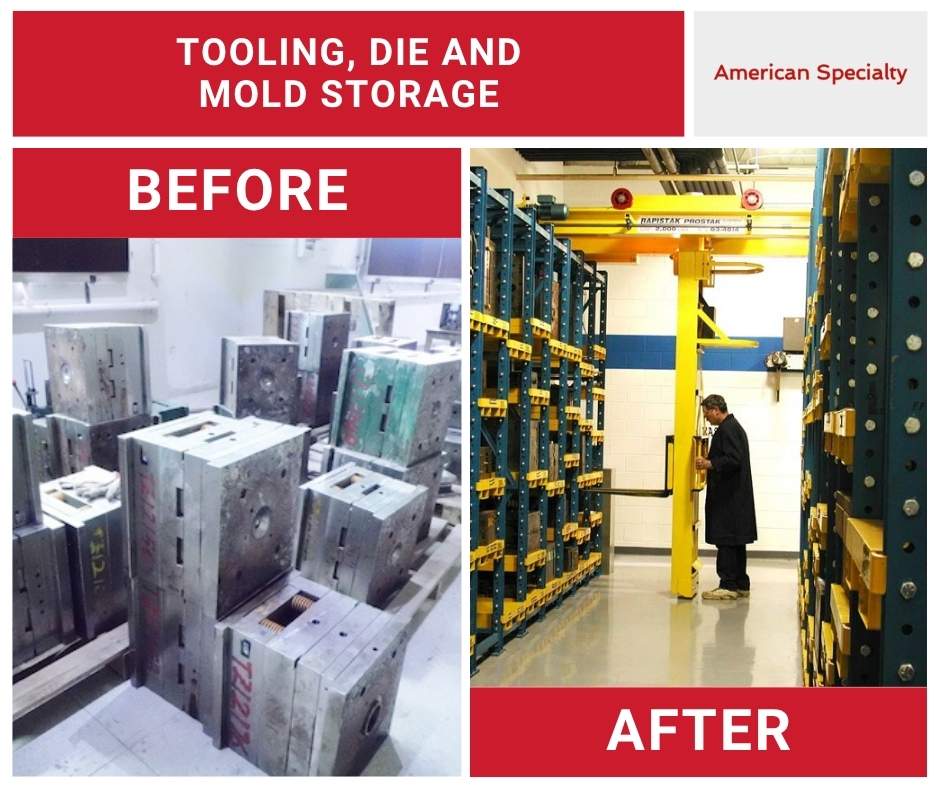
In manufacturing environments where precision, uptime, and safety are non-negotiable, tooling, die and mold storage play a critical role in overall operational success.
These assets are often heavy, uniquely shaped, and essential to production. Because they are not always in constant use, proper storage becomes critical for maintaining efficiency. Modern vertical storage systems have evolved to meet these challenges, offering engineered solutions that protect valuable equipment while optimizing space and workflow.
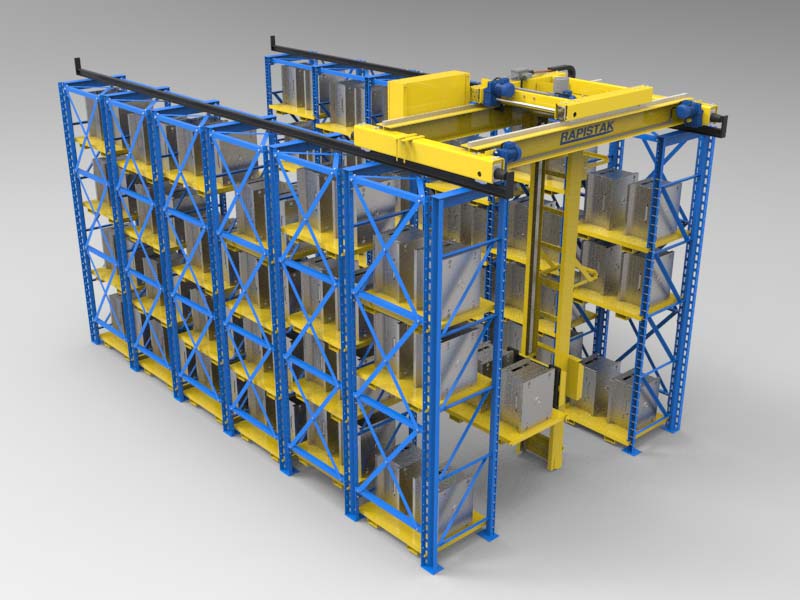 Effective tooling, die and mold storage begins with an emphasis on safety. Many traditional storage methods rely heavily on forklifts or manual handling. Both introduce risk when dealing with thousands of pounds of steel.
Advanced vertical storage systems have the ability to reduce or remove the need for a forklift, minimizing the chance of collision, tip-over, or operator strain. By incorporating mechanical lift assistance, stacker cranes, or automated retrieval devices, facilities can streamline the handling of heavy materials while ensuring the safety of employees.
Space optimization is another advantage of well-designed tooling, die and mold storage systems. Instead of utilizing valuable floor space on a sea of heavy tool storage, vertical racking solutions leverage ceiling heights, often up to 25 feet, allowing operations to increase storage density without expanding their footprint.
Load capacities typically range from 2,000 to 10,000 pounds per shelf. This allows for the larger molds or dies to be stored safely in a compact, accessible layout. These systems are typically modular and reconfigurable, allowing facilities to adjust the configuration as tooling requirements evolve.
Smaller tooling, components, and maintenance parts also benefit from specialized rack designs. Glide-out or crank-out shelves reduce reach and lifting strain while allowing workers to access inventory from either side of the rack.
Heavy-duty steel shelves, commonly rated up to 5,000 pounds per level, extend outward up to 75%, allowing tools to be handled safely even in tight working spaces. Many of these systems can be built in custom dimensions, ensuring proper fit for irregularly shaped tools or niche applications.
Automation is becoming part of everyday tooling, die and mold storage as well. Facilities with high volumes of molds or remote storage areas can employ automated vertical systems equipped with gripper devices to retrieve items without human intervention.
For heavier or bulkier equipment, stacker lift systems enable operators to reposition and store items with the push of a button, eliminating manual lifting and significantly reducing downtime.
The ability to reconfigure shelf heights on demand also ensures that tooling, die and mold storage systems can adapt to varying tool sizes without requiring a redesign.
As storage becomes interconnected, tracking technology is also transforming how tooling is managed. Web-based inventory systems provide real-time insight into tool location, usage patterns, and maintenance needs. This level of visibility reduces search time, prevents misplaced assets, and supports better production planning by ensuring tools are available when needed.
Predictive tracking additionally contributes to longer tool life by helping maintenance teams schedule care before issues arise.
The operational benefits of advanced tooling, die and mold storage solutions are substantial. Manufacturers see faster retrieval times, reduced labor strain, improved safety metrics, and more efficient use of space.
Better storage conditions help protect tools from environmental damage, extending their service life and reducing replacement costs. When combined with potential tax benefits, such as those available under Section 179, modern storage systems offer both functional and financial advantages.
Ultimately, tooling, die and mold storage is an engineering challenge with direct implications for production flow and workplace safety. Well-designed storage systems address these challenges by providing strong, adaptable, and space-efficient solutions that support high-performance manufacturing operations.
If you would like to learn how tooling, die and mold storage systems can be integrated into your facilities, contact the experts at American Specialty.
