 Skip to content

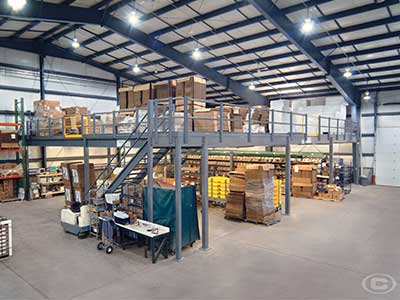
Industrial mezzanines offer a proven solution by transforming unused vertical space into functional, load-bearing areas that support storage, production, and workflow needs.
One of the greatest advantages of industrial mezzanines is their ability to expand usable space without the cost and disruption of traditional construction. Instead of building additions or leasing off-site storage, companies can invest in a mezzanine system that installs faster, costs less, and delivers immediate operational benefits.
 In many cases, these structures are considered equipment rather than permanent structures. This means they can also offer tax advantages and faster approval timelines compared to new construction projects.
Industrial mezzanines are engineered with structural steel components to handle demanding load requirements. These systems can be designed to support palletized inventory, shelving systems, conveyors, machinery, and even integrated workspaces. Load capacities are customized based on usage, ensuring long-term safety and durability.
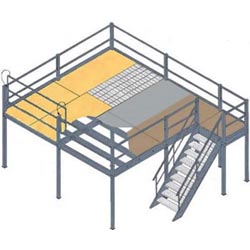
Decking options, column spacing, and support structures are selected to match operational demands, creating a platform that functions as seamlessly as the original building floor.
No two facilities operate the same way, which is why industrial mezzanines are fully customizable. Systems can be designed as free-standing platforms or integrated with existing racking to create efficient, multi-level storage and work areas.
Industrial mezzanines can also be configured to include stairs, gates, lifts, conveyors, and safety railings. These elements ensure the smooth movement of people and materials between levels.
Improving Workflow and Productivity with Industrial Mezzanines
Strategically designed industrial mezzanines help organize operations by separating functions vertically. Bulk storage can be placed above, while picking, packing, or assembly remains at ground level. This separation reduces congestion, shortens travel distances, and improves overall productivity.
In distribution and fulfillment environments, industrial mezzanines create multi-level pick modules that increase order throughput.
Industrial mezzanines are built with future growth in mind. Mezzanine systems can be expanded, reconfigured, or relocated. This adaptability is especially valuable for growing companies that need space solutions capable of evolving with demand.
Industrial mezzanines are used across a wide range of industries and applications.
- Warehouses rely on them to increase storage density and manage seasonal inventory.
- Manufacturing facilities use mezzanines for parts storage, sub-assembly areas, or quality control zones.
- Distribution centers integrate mezzanines with conveyors and picking systems to streamline fulfillment.
In each case, the goal is the same: to maximize vertical space while maintaining safe and efficient operations.
Safety and Compliance Built In
Properly designed industrial mezzanines prioritize safety and performance. Systems are engineered to meet applicable building codes and industry standards, incorporating guardrails, handrails, stair systems, and access points that support daily use.
Professional design and installation ensure the mezzanine integrates seamlessly into the facility while providing a secure working environment for employees.
Industrial mezzanines are a powerful solution for facilities that need more space without expanding their footprint. By leveraging vertical height, improving workflow, and supporting heavy-duty applications, industrial mezzanines allow businesses to operate more efficiently and plan confidently for the future.
When designed with expertise and installed with precision, industrial mezzanines turn unused airspace into a strategic advantage.
