 Skip to content

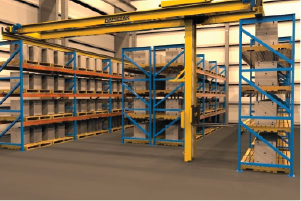
Businesses seeking an edge increasingly turn to warehouse stacker cranes. These machines are now a core part of automated storage and retrieval systems.
These advanced solutions maximize vertical space. They also streamline material handling and deliver high-performance inventory movement in demanding environments.
Warehouse stacker cranes operate within narrow aisles, traveling horizontally along rails while simultaneously lifting loads vertically to precise rack locations. This dual-axis movement allows goods to be stored and retrieved quickly and accurately, even in high-bay warehouse configurations.
By automating what was once a labor-intensive process, stacker cranes help create a more efficient, predictable, and scalable operation.
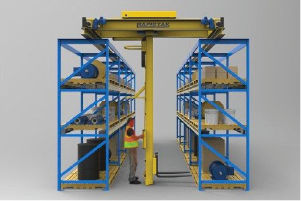 One of the most significant advantages of warehouse stacker cranes is their ability to dramatically increase storage density. Traditional forklift operations require wide aisles and limit vertical reach. This results in valuable cubic space being underutilized.
Stacker cranes, by contrast, are engineered to operate in very narrow aisles and reach substantial heights. This enables facilities to store more inventory within the same footprint, often reducing or eliminating the need for costly building expansions.
In addition to space savings, warehouse stacker cranes significantly improve productivity. Automated movements reduce cycle times by transporting loads directly to and from designated storage locations without unnecessary handling.
These systems eliminate bottlenecks and support faster order fulfillment by operating with consistent speed and precision. The result is a smoother material flow that keeps pace with high-volume operations and growing customer expectations.
Safety is another critical area where warehouse stacker cranes deliver measurable benefits. Manual material handling and forklift traffic are among the leading causes of warehouse accidents. By automating storage and retrieval within enclosed aisles, stacker cranes reduce the need for personnel to work near moving loads or at elevated heights.
This not only improves workplace safety but also allows employees to focus on higher-value tasks that require human oversight and decision-making.
Warehouse stacker cranes also play a role in inventory accuracy and control. When integrated with a warehouse management system, every movement is tracked in real time. Inventory locations are automatically updated, reducing discrepancies and improving traceability. This level of visibility supports better forecasting, simplifies audits, and provides the data to make informed operational decisions.
The versatility of warehouse stacker cranes makes them well-suited for a wide range of industries.
- E-commerce and retail distribution centers rely on their speed and accuracy to meet tight delivery timelines.
- Manufacturing facilities benefit from reliable handling of heavy or bulky materials.
- Cold storage operations depend on their consistent performance in temperature-controlled environments.
- Pharmaceutical and chemical warehouses value the precision and traceability these systems provide.
Successful implementation of warehouse stacker cranes begins with thoughtful system design. Racking must be engineered to support automated operation, and crane specifications must align with load weights, storage heights, and throughput requirements.
Control systems and software integration are equally important, ensuring seamless communication between the crane, conveyors, and warehouse management platforms. When these elements are properly aligned, stacker crane systems deliver long-term reliability and strong returns on investment.
As automation continues to shape the future of logistics, warehouse stacker cranes remain a cornerstone technology for modern facilities. Their ability to optimize space, improve efficiency, enhance safety, and deliver real-time inventory insight makes them an essential solution for businesses focused on growth and operational excellence.
Investing in warehouse stacker cranes is not just about automation today; it is about building a smarter, more resilient warehouse for the future. Start future-proofing your warehouses today.
